Short answer: SEO gives better ROI after about a year. PPC gives better ROI in the first 90 days. Organic leads cost about $31 each. Paid leads cost about $198 each. But if you need customers this month and your site does not rank yet, paid ads are the right first spend. This guide shows the real numbers, so you can pick with confidence.
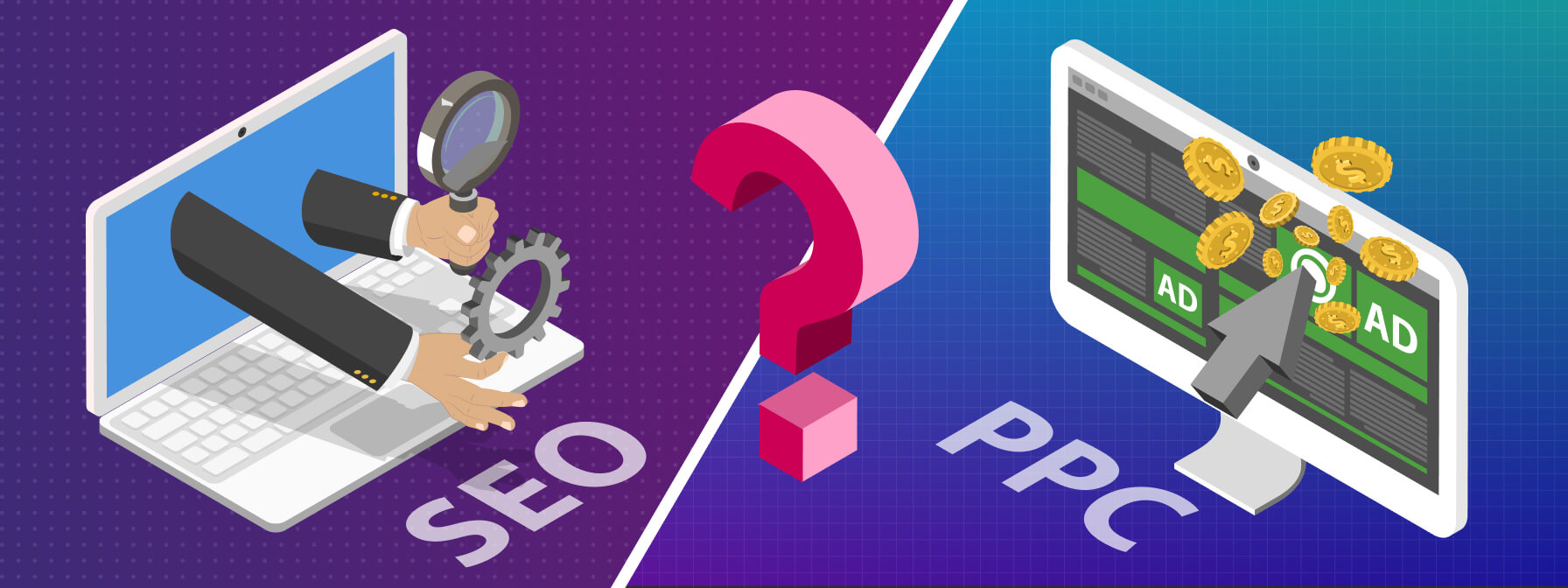
Every small business owner asks the same question at some point. Should you spend money on search engine optimization (SEO), or should you pay for pay-per-click advertising (PPC)? Both aim to bring in customers. But they work in very different ways.
This guide compares organic search vs paid search using real numbers. You will learn the true cost per lead, the cost per click, and the cost per acquisition for each channel. You will also learn which one gives you better digital marketing ROI over time. By the end, you will know how to build a smart digital marketing strategy for your small business marketing goals.
SEO vs. PPC Based on Your Situation
This search marketing channel comparison is not the same for every business. Find your row in the table below.
| Your situation | Start with | Why |
| You need leads in under 30 days | PPC | Traffic starts on day one |
| Your budget is under $1,500 a month | One channel only | Split budgets fail at both |
| Your site already ranks for some terms | SEO | You have a base to build on |
| Your domain is brand new | PPC first, SEO in the background | Ranking takes 6 to 12 months |
| Your sales spike at certain times of year | PPC | You control the timing |
| Your clicks cost more than $8 | SEO | Paid math is hard to win |
The choice is really about short-term wins vs long-term growth. Paid ads rent traffic. SEO builds an asset you own.
Three Questions That Decide It
1. How soon do you need a customer? Under 30 days means paid. Over 6 months means organic.
2. How many months of cash do you have? Your cash flow and marketing runway matter more than any benchmark. SEO needs at least 6 months of steady spend to prove itself.
3. What does a click cost in your field? A dentist paying $8.00 per click uses very different math than a shop paying $1.63 per click.
What Each Channel Costs a Small Business in 2026

Real PPC Costs
Pay-per-click advertising means you pay each time someone clicks your ad. WordStream studied more than 13,000 US search campaigns. The average CPC hit $5.42 in 2026, more than double the $2.32 recorded a decade earlier. The average cost per lead (CPL) sits near $70.
Here is how clicks price out by field:
| Industry | Average CPC |
| Attorneys and legal services | $9.87 |
| Home and home improvement | $8.33 |
| Dentists and dental services | $8.00 |
| Cross-industry average | $5.42 |
| Travel | $2.14 |
| Restaurants and food | $2.05 |
| Arts and entertainment | $1.63 |
Most small firms spend $1,000 to $5,000 a month on ads. That is your daily ad budget times 30. Keep in mind that Google Ads runs on an auction. Your real price depends on your bid, your Quality Score, and who else is bidding. Those ad auction dynamics change every single day.
Real SEO Costs
Search engine optimization services are usually sold as a monthly fee. Ahrefs surveyed hundreds of providers. The average SEO agency retainer cost was $3,209 for agencies, $3,250 for consultants, and $1,348.63 for freelancers. The most common price band was $501 to $1,000 a month.
Backlinko surveyed more than 300 SEO professionals and found a similar range of $1,000 to $2,500 per month. For small and mid-size firms in the US, plan on $1,500 to $3,000 a month. Local work often starts lower. One change in 2026 is worth noting. Optimizing for AI answers is now part of most plans, and that adds to the price.
The Costs Nobody Quotes You
Your real bill includes more than the headline number:
- PPC management fees, often 10% to 20% of your ad spend
- Landing page design and building
- Content writing for blog posts and service pages
- Conversion tracking setup and call tracking
- Your own time if you go the DIY SEO for small business route
This is why in-house vs agency marketing is a real question. An agency costs more per month but usually moves faster.
The ROI Math, Side by Side

Cost Per Lead
Organic search generates leads at roughly $31 each, compared with about $198 per lead from paid search, according to SeoProfy.
The difference is substantial: organic leads cost about 84% less. At those cost-per-lead rates, the same budget would produce approximately 6.4 times as many leads through organic search as through paid search.
That is the whole case for SEO in one line. A $2,500 monthly budget buys about 13 paid leads. The same $2,500 spent on a mature SEO program buys about 81.
One caveat you should know about. The $198 figure is an average across paid channels, not just search ads. If your ads are search-only and well managed, your real number will fall somewhere between $70 and $198, and the gap narrows significantly.
Conversion Rates
Site visitors from organic search convert at about 2.4%. Paid visitors convert at about 1.3%. There is a twist worth knowing. One study found that visitors from ads are 35% more likely to convert on high-intent transactional searches because you can target people who are ready to buy rather than those still reading. Strong landing page experience and steady conversion rate optimization matter more than the channel here.
The ROI Numbers, With an Honest Warning
You will see two numbers quoted in almost every article on this topic:
- SEO: 748% ROI, or $7.48 back for every $1 spent
- PPC: 36% ROI over the long run
Here are the actual numbers.
The 748% figure is real, but it does not apply to small businesses. This figure is a median across thought leadership campaigns, averaged over three years, for clients paying roughly $120,000 a year. That is about $10,000 a month. If your budget is $2,000 per month, this number does not apply to you.
PPC returns are largely linear: spend $1,000 and receive a certain number of clicks; to generate more clicks next month, you usually need to spend more. On the other hand, SEO can compound. A page published today may continue attracting traffic and leads for years without a corresponding increase in media spend. That cumulative return is the central case for investing in organic search.
A 24-Month Model on a $2,500 Monthly Budget
This is a calculation, not a study. Each number below follows the rules here, so you can rebuild it yourself using your own figures.
The rules:
- The total budget is $2,500 per month across both channels for 24 months, totaling $60,000.
- PPC path: a 15% management fee comes off the top, leaving $2,125 in real ad spend. At $198 per lead, that is 11 leads a month, every month.
- SEO path: the full $2,500 goes to the retainer. At the mature rate of $31 per lead, that budget tops out at about 81 leads per month. Nothing ranks for the first two months. Month three produces 4 leads. From there, the number grows about 28% a month until it reaches that ceiling.
- Split path: $1,500 to ads (6 leads a month) and $1,000 to SEO. The smaller retainer buys about 40% of the content output and starts one month later.
| Month | PPC only | SEO only | 60/40 split |
| 1 | 11 | 0 | 6 |
| 3 | 11 | 4 | 6 |
| 6 | 11 | 8 | 9 |
| 9 | 11 | 18 | 12 |
| 12 | 11 | 37 | 18 |
| 15 | 11 | 77 | 31 |
| 18 | 11 | 81 | 39 |
| 24 | 11 | 81 | 39 |
Totals over the full 24 months on the same $60,000:
| Path | Total leads | Blended cost per lead |
| PPC only | 258 | $233 |
| SEO only | 1,065 | $56 |
| 60/40 split | 548 | $109 |
Four things in this table matter more than the totals.
SEO passes PPC on monthly volume in month 7. That is much faster than most people expect, and it happens because a $198 paid lead sets a low bar to beat.
On total leads, SEO catches up in month 12. Monthly crossover and cumulative crossover are different events. Most articles quietly report only the first one.
The blended SEO cost of $56 does not match the $31 headline. The $31 rate describes a mature campaign. The $56 figure includes all the empty early months when you paid and got almost nothing. Both are true. They answer different questions.
The split path produces fewer leads than SEO alone. What it buys instead is steadiness. You never drop below 6 leads a month, and you are not betting the business on a single channel. For most owners, that trade is worth making, but make it with your eyes open.
A sensitivity check, because it matters. Rerun the same model with a search-only cost per lead of $70 instead of $198, and paid produces 30 leads a month rather than 11. SEO then does not pass PPC monthly until month 12, and does not catch up on totals until month 18. That single input changes the answer by six months. It is the reason you should pull your own cost per lead before deciding anything.
Set your break-even analysis around a 12- to 18-month payback period, not a 90-day one.
Where PPC Really Wins
Paid search earns its place. Here is what it does better:
- Speed. Your paid search ads can run within hours of account setup.
- Testing. You can test commercial intent keywords with real money before you write a single blog post. If a term does not convert in ads, do not build content for it.
- Control. You choose the city, the hours, and the devices. A clear Google Ads campaign structure keeps that control tidy as you grow. This makes paid strong for service area business marketing.
- Predictable volume. Need 20 more leads next month? Raise the budget.
- Seasonal advertising campaigns. Turn it on in December and off in January.
There is one hard truth about ads. The moment you stop paying, the leads stop arriving. Agencies report the same pattern again and again: a client pauses spend during a slow cash month, and the pipeline empties within days. Paid traffic is rented, never owned.
Watch out for wasted ad spend too. Without a tight negative keyword list, you will pay for clicks from people who will never buy.
Where SEO Really Wins
- Traffic share. BrightEdge research shows organic search drives 53% of trackable website traffic.
- Lower cost over time. Your cost per lead falls as organic search rankings improve.
- Ownership. The content stays yours. So does the backlink profile you build.
- Trust. Many people skip ads on purpose.
- Local visibility. Local SEO puts you in the map results where nearby buyers look first.
For local service business lead generation, the map results matter most. That means a complete Google Business Profile, real reviews, and NAP citation consistency across the web. Your name, address, and phone number must match across all platforms, including Yelp and Apple Business Connect. This is how you earn map pack rankings.
How AI Search Changed This Comparison in 2026

Google AI Overviews now appear on 48% of all searches. That is up 58% in one year, according to BrightEdge tracking. When one appears, click-through rate (CTR) on organic results drops by 34% to 61%. Seer Interactive studied 25 million impressions and saw organic CTR fall from 1.62% to 0.61%.
Meanwhile, zero-click searches keep rising. Similarweb found that 68% of Google searches now end without a click.
So does this AI Overviews impact on traffic mean you should move money to ads? No. Paid CTR has fallen even further than organic on these searches. And there is a bright side. Brands that get named inside an AI answer earn 35% more organic clicks and 91% more paid clicks than brands that do not.
That changes the goal. You are no longer only trying to rank. You are trying to get quoted. This work has two names. Generative engine optimization (GEO) covers being cited by tools like ChatGPT and Perplexity. Answer engine optimization (AEO) covers being cited inside AI Overviews and Google AI Mode search results. GoodFirms found that 43% of marketers were doing this work in 2026, up from nearly zero the year before.
This is also called SERP feature erosion. Ads, map packs, and AI boxes push the classic blue links further down the page. Bain and Company has described this shift as structural rather than temporary, which is why the paid search vs organic search debate now has to account for it.
What to Ask an Agency About GEO
- How will you win AI citations and brand mentions?
- Do you write short answer blocks of 40 to 60 words that a machine can lift cleanly?
- Do you add schema markup and structured data, such as FAQ and HowTo?
- Do you check my brand facts across LinkedIn, Wikipedia, and Google Business Profile?
- How do you handle featured snippet optimization?
Good news for the basics. E-E-A-T signals, strong domain authority, and honest link building still matter. Google’s John Mueller and Danny Sullivan have both said for years that helpful content written by real experts is the durable path. That has not changed.
How to Split a Small Business Marketing Budget
Your marketing budget allocation should match your stage, not a template. Here is a simple channel mix strategy.
Under $1,000 a Month
Pick one. A limited advertising budget spread across two channels does neither job. If you need cash this quarter, run ads on a few bottom-of-funnel keywords only. If you can wait, put it all into content and technical fixes.
$1,000 to $3,000 a Month
Use a 70/30 rule. Put 70% into the channel that fits your timeline. Put 30% into the other one. Most new firms start 70% paid. Most firms with an established site start 70% organic.
Over $3,000 a Month
Now you can run SEO and PPC together in a single plan. This is a true integrated search strategy. The best part is that your ad data feeds your content marketing strategy. Your search terms report shows exactly which phrases turn into sales. Build pages for those.
When to Shift the Ratio
Check every quarter. When organic leads reach 30% of your total, move 10% of the ad budget over to content. Repeat until the mix feels stable. Watch for diminishing returns in ads. If your impression share is already above 80%, more money will not buy much more volume.
How to Measure ROI the Right Way

You cannot judge which channel delivers better ROI without clean data. Here is the setup.
Step 1. Install the basics. Use Google Analytics 4 for traffic and conversions. Use Google Tag Manager to fire your tags. Use Google Search Console for organic clicks and queries. Add Bing Webmaster Tools too, since Microsoft Advertising traffic is cheap in some fields.
Step 2. Track the right numbers. Focus on cost per acquisition (CPA), customer acquisition cost (CAC), and customer lifetime value (CLV). Your CLV-to-CAC ratio should be 3:1 or better. Below that, you are buying customers at a loss.
Step 3. Use a simple marketing ROI formula. Revenue minus cost, divided by cost, times 100. Nothing fancy.
Step 4. Know your unit economics. Work out your profit margin per closed deal first. A $200 lead is a bargain for a law firm and a disaster for a pizza shop.
Step 5. Look at blended numbers. Your blended cost per acquisition across every channel tells the truth better than any single report. Add incremental revenue attribution to see which channel actually drove the sale.
Step 6. Score your leads. Volume is not value. Lead quality scoring separates real buyers from tire kickers. Track qualified lead volume, not raw form fills.
Step 7. Separate two KPIs. Falling CTR with rising conversion rate is not a failure. In 2026, that pattern is normal.
Build one dashboard in Looker Studio, so your sales funnel stages sit on a single screen. HubSpot works well if you need a CRM attached.
Which Fields Should Lean Which Way?
Plumber, dentist, and law firm marketing all face high click prices and a competitive local market. For these, organic plus map results usually win the long game. Ads still make sense for emergency terms, where someone needs help right now.
Shops and restaurants have cheap clicks. Ads can pay off fast there.
B2B firms with long sales cycles need both. Gartner and Bain & Company research both indicate that buyers do most of their research on their own before they ever contact a vendor. That research happens in organic results and AI answers.
Frequently Asked Questions
Is SEO or PPC better for a small business?
SEO gives better long-term ROI for most small firms. PPC gives faster results. If you need leads within 30 days, start with ads. If you can wait 6 months, start with SEO.
How long does SEO take to work?
Most firms see real movement in 3 to 6 months. Competitive fields take 6 to 12 months. How long SEO takes to work depends on your site’s age, content quality, page speed optimization, and Core Web Vitals scores.
How much should a small business spend on Google Ads per month?
Most spend $1,000 to $5,000 a month. Work backward instead of guessing. Decide how many leads you need, then multiply by your industry’s cost per lead.
Can I do SEO and PPC simultaneously on a small budget?
Yes, but only above about $1,500 a month. Below that, one channel done well beats two done badly.
Is PPC worth it if my clicks are expensive?
Sometimes. A $9.87 click is fine if one client is worth $10,000. Check your margins first.
Does SEO still work with AI Overviews?
Yes, but the goal has shifted. You now want to be the source for AI-generated quotes. Backlinks and quality content still drive that.
Should I hire an agency or do it myself?
Do it yourself if you have 10 hours a week to spare. Hire help if you do not. Off-page SEO and link building are the hardest parts to do on your own.
What ROI should I expect in year one?
On a $2,500 budget, expect SEO to pass ads on monthly leads around month 7 and on total leads around month 12. Expect positive ROI from ads within the first 60 days if your tracking and landing pages are solid.
The Final Verdict
For sustainable lead generation, SEO is the better investment for most small businesses. It costs less per lead, it compounds, and you own the result. But it asks for patience and steady spend.
PPC is the better first move when speed matters more than efficiency. It is also the fastest way to learn what your buyers actually search for.
The smartest small firms stop asking “SEO vs PPC” and start asking “what ratio, and when do I change it?” Start where your cash flow points. Shift as your rankings grow. Measure everything.